In May 2025, Hakuhodo teamed up with DAZN (pronounced "da zone"), provider of a sports streaming service, to tackle the challenge of delivering a new type of viewer experience while generating advertising creative centered on emotions by leveraging AI to visualize the emotions of sports viewers. But how can AI visualize emotions? What is the budding future of marketing? Trying to answer these questions are Yu Sasamoto, CEO at DAZN, and Koichiro Shima, Corporate Officer at Hakuhodo.
Related release: Hakuhodo enters into a strategic partnership with DAZN, a sports streaming service
Contents
1. Visualizing the emotions of sports viewers for marketing that strikes the right chord
2. DAZN and Hakuhodo to employ a unique algorithm to analyze the quantity and quality of emotions
3. Sense of belonging that drives fans and sponsors to develop a sports-enjoying culture together
4. Business chance for any company: Finding an advertising opportunity in every emotion
Visualizing the emotions of sports viewers for marketing to strike the right chord
Q: How did this partnership come about? What do DAZN and Hakuhodo each expect from it?
SASAMOTO
Our job is to livecast sports games. Sports are the most empathetic content as people clearly get emotional when watching sports games. That's why I thought it would be interesting to visualize the emotions of viewers rather than simply delivering games. And that's where it all began. For example, someone hits a home run in a baseball game, and you get excited and thirsty. That's when it's time for a drink commercial. I'm sure this will offer new value for advertisers.

SHIMA
DAZN has captured the sentiments of sports viewers to grow into a platform for more active content viewing. By combining the "fandom" content of DAZN, the sei-katsu-sha insight and creativity of Hakuhodo and technology, we hope to bring deeper experiences to sei-katsu-sha (our term for the holistic person), and novel marketing techniques to clients.
Q: DAZN focuses heavily on the value and energy of "fandom." What exactly is "fandom"?
SASAMOTO
It collectively refers to sports viewers, but unlike a fan club, they form a community to share a specific atmosphere characterized by enthusiasm and immersion. I think of it as a community that allows its members to let it all out.
SHIMA
The world of sports has a huge background. We enjoy it as stories like: "How will last year's losing team do this year?" In this world, viewers are more often like team members than bystanders.
One of DAZN's strengths is that it offers content that viewers can enjoy actively, instead of sitting still--and all this anywhere, anytime on your smartphone or other device. What a platform!
SASAMOTO
The smartphone greatly facilitates personalization. You can also consider fandom in terms of identifying with the player you love, because viewers often identify themselves with a specific player, rather than supporting a whole team.
SHIMA
I understand. Sports are interesting because different viewers have different perspectives and stories in mind even when watching the same game. It's very emotional content, indeed.
Our challenge is to upgrade both the viewing experience of users and the advertising business by visualizing emotions with technology. Fandom-focused marketing itself is in line with the times, but we are aiming to refine it with data-driven visualization to realize marketing "that strikes the right chord." I am thrilled to be able to embark on this challenging endeavor in partnership with DAZN.

DAZN and Hakuhodo to employ a unique algorithm to analyze the quantity and quality of emotions
Q: What do you mean by "visualizing emotions with data?"
SHIMA
In the course of a game, we pick up multiple datasets including on the location of the ball and the time remaining to quantify the strength of viewers' emotions. In other words, this is a quantitative analysis of emotions.
We also deal with types of emotions. Based on Russell's circumplex model of emotions, we analyze whether viewers are tense or delighted. As multiple emotions emerge in a single game, it is possible to deliver the right ad at the right time by visualizing them.
- Russell's circumplex model of emotions is a dimensional model of emotions suggesting that emotions are distributed in a circular space containing two dimensions: activation-deactivation and pleasant-unpleasant.
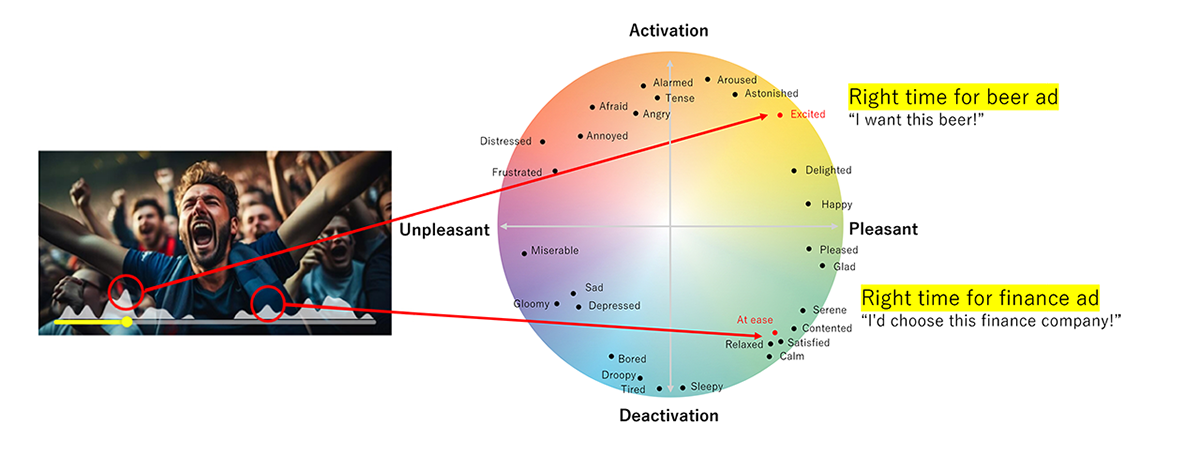
In visualizing both the quantity and quality of emotions, we have to develop an "eye" to identify trigger points for the response of sports fans. We thus need to have a feel for the combinations of variables that arouse the emotions of people, in addition to measurable data. DAZN and Hakuhodo are working together to develop a distinctive algorithm by integrating our insights about sports fans such as: "This is where football fans get excited." Currently, we are also conducting field tests in order to refine the algorithm, including by measuring spectators' heart rate while they are watching a game at the stadium.
SASAMOTO
I can't wait to see the result. We are really starting to meet the challenge of visualizing the value of sports viewing.
Conventionally, numerical data on viewership have been linked to the value of advertising for TV and streaming services like ours, so we had to remain passive in a sense. But our present initiative will allow us to adapt our communication to the emotions of viewers in real-time. This means that we will be able to discern which emotion has an affinity to a specific brand. I am thrilled by the possibility of offering a unique value above and beyond the traditional sponsorship.
SHIMA
That's because this is the very first attempt at this level of refinement to deliver ads that strike the right chord, moving one step ahead of measuring the size and demographics of viewership. I am really excited by the prospect of revolutionizing the techniques of marketing.
In this digital era, advertisements tend to be treated as a nuisance. By delivering ads that strike the right chord, we might be able to bridge the gap between advertisers and fans, if the latter come to recognize: "This advertiser knows exactly how I feel."
Sense of belonging that drives fans and sponsors to develop a sports-enjoying culture together
Q: Does that mean ads may not only stop interrupting the viewer experience but also be beneficial for viewers?
SASAMOTO
That's right. Sports are deeply embedded in our DNA as content; they are sometimes referred to as the earliest form of entertainment for humans.
Many companies have become sponsors of sports for branding purposes saying: "We are a company rooting for this team with its supporters." But going forward, I think they will be capable of more emotionally involved branding.
SHIMA
This year's Cannes Lions also recognized activities that connect sei-katsu-sha and a brand to support a culture. Fans and sponsors getting together to develop a culture to enjoy sports reflects their "sense of belonging."
SASAMOTO
That's right. There is sustainability in a sense of belonging. Our initiative will develop into a system that effectively improves brand penetration, not only brand awareness.
SHIMA
In addition to a sense of belonging ("This brand really knows who we are."), brands will be able to deliver information that strikes the right chord at the right moment. This will surely boost the impact and reach of advertising.
Q: What kind of viewing experience can we expect as users?
SASAMOTO
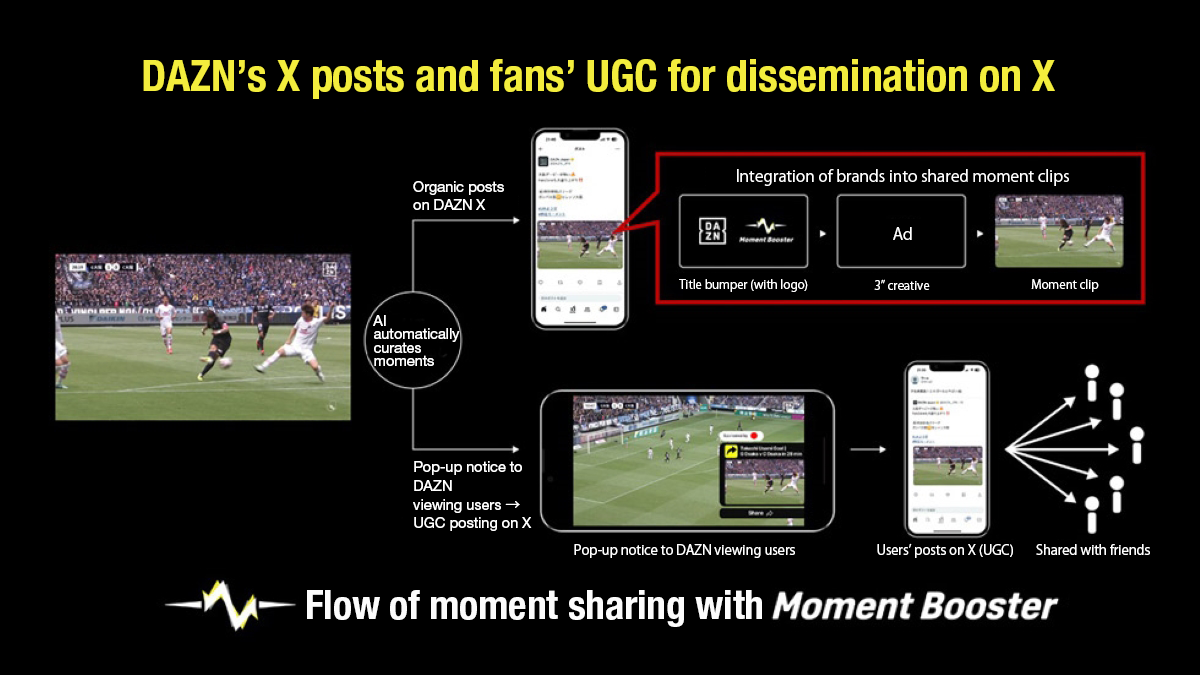
With Moment Booster,* which we introduced this year, AI automatically creates a video by picking up clips of goals and red cards, to be shared by viewers on social media without restriction. We are currently instructing AI to curate scenes that obviously excite everyone, but further visualization of emotions might reveal that people get excited at unexpected moments. Combining sports moments with the emotional moments of supporters can accelerate evolution going forward.
SHIMA
We hope to discover unexpectedly exciting moments like: "It was this scene that really moved me." Everybody wants to share the moments when their favorite player shines. Technologies like Moment Booster facilitate interaction among fans while such positive motivation helps disseminate ads. For viewers who share their excitement, that's a brand-new kind of enjoyable experience.
As mentioned earlier, corporate sponsorship of sports is a traditional marketing technique but has not evolved much until now. This initiative of leveraging emotional data and AI will be a novel experiment for clients, too. It would be very interesting to explore what kind of product is suited for a specific emotion.
Business chance for any company: Finding an advertising opportunity in every emotion
Q: If it is possible to place ads in response to people's emotions, even companies remotely connected to sports might have a chance.
SHIMA
Yes. Even those who have been thinking that their products are not for sports might find new business opportunities.
SASAMOTO
Emotionally responsive communication is one of the most basic requirements for marketing, isn't it? Sports form an emotionally charged entertainment every moment of the way. You may find a campaign that fits with the seemingly negative emotion of anger. I believe you can find an advertising opportunity in any emotion.
SHIMA
For instance, I wonder what kind of ad goes with a pitcher change in a clutch situation. It would be interesting to see if that will provide a new creative perspective for ad creators.
SASAMOTO
That would be a clutch situation for creators, too.
Q: I heard that DAZN and Hakuhodo launched a creative team for this project. What kind of challenges will they address?
SHIMA
Sports are not only about gameday, but also offer content to be enjoyed along with long stories including the process leading to the games. It will thus be crucial that every single advertising copy is written by someone who really loves sports.
DAZN has a sport-loving creative team. Creative team members from Hakuhodo joined that team to form DAZN Creative for Brand. This joint team will meet the challenge of delivering a new kind of marketing through the collaboration of DAZN's fundamental culture and our team of creative data analysts.

SASAMOTO
I hope this kind of experimental initiative will give birth to a new style of creative recognized both inside and outside Japan.
Our vision is to invigorate Japan through sports. Let's keep tackling challenges together to give a further boost to sports and pioneer brand-new marketing.
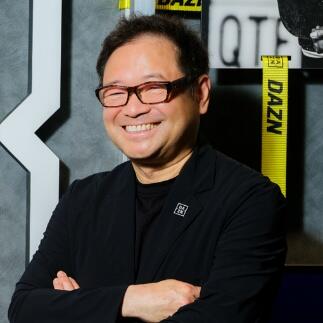
Yu Sasamoto
DAZN Japan CEO
Born in 1964 in Bangkok, Thailand, Yu Sasamoto joined Recruit Co., Ltd. in 1988. He was appointed Director & COO of MTV Japan, Inc. in 2000, and promoted to Representative Director & CEO in 2002. In 2007, he joined Microsoft Co., Ltd. as Senior Corporate Officer and assumed responsibility for the whole Asia-Pacific region in 2009. He was appointed Representative Director at Twitter Japan Corp. in 2014 before becoming CEO at DAZN Japan/Asia in 2024. Currently, his other positions include Outside Director at Kadokawa Corporation and Sanrio Co., Ltd. In August 2024, he published Elon shock: Moto Twitter Japan shacho ga mita "hakai to sōzō no 215 nichi" (Elon Shock: 215 Days of "Destruction and Creation" as Seen by a Former Twitter Japan President).

Koichiro Shima
Corporate Officer & Executive Creative Director, Hakuhodo Inc.
After joining Hakuhodo in 1993, Koichiro Shima served as Editor in Chief of Kohkoku, a magazine published by Hakuhodo in 2002-2004, participating in the creation of the Japan Bookseller's Award. He launched Hakuhodo Kettle in 2006, executing a large number of integrated campaigns. He has also been involved in the content business including magazine editing, radio program production and online news site operation. He is the author of publications including Yokubō suru "kotoba": "Shakai kigō" to marketing (Words That Desire: Social Trend Term and Marketing). In addition, he has served as a jury member at numerous award shows including Cannes Lions Festival of Creativity and ACC Tokyo Creativity Awards.